
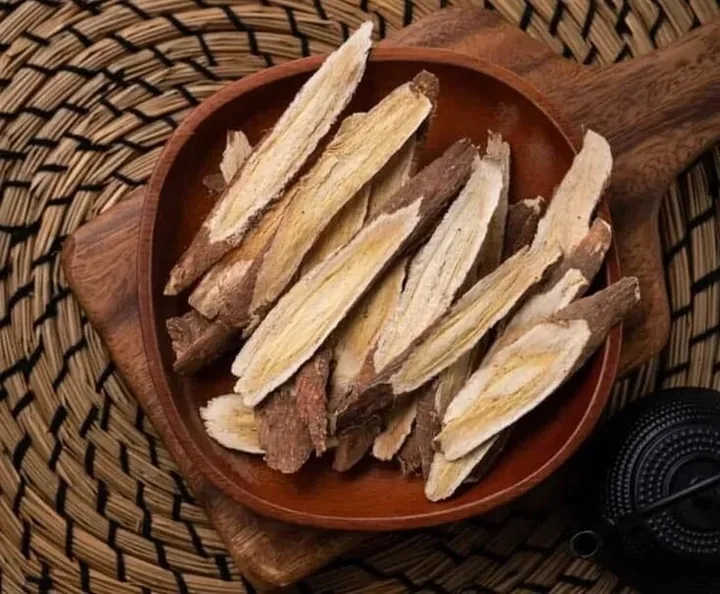
Astragalus root (Astragalus membranaceus, or huang qi) is a traditional Chinese tonic taken daily to support the immune system and resilience to stress over time. Its best-studied compounds are polysaccharides and astragalosides. It is generally well tolerated; people with autoimmune conditions or on immune-suppressing medication should talk to a doctor first.
What Is Astragalus Root?
Astragalus root comes from Astragalus membranaceus, a flowering plant in the legume family — the same family as beans, peas, and clover. It grows wild across the grasslands and meadows of northern China, Mongolia, and Siberia, thriving in dry, open terrain where winters are harsh and summers are short. The plant itself looks unassuming: small purple or yellow flowers, feathery leaves, and an unremarkable stem. But what happens underground is the whole story.
The root is the medicinal part. After four to seven years of slow growth, the root becomes thick, fibrous, and rich with some of the most studied plant compounds in all of herbal medicine. In its dried form it looks like a flat, woody stick — pale yellow on the inside, which is exactly where its name comes from. Huang Qi in Chinese means “yellow leader” or “yellow emperor.” Ancient herbalists named it that because they considered it the supreme tonic — the leader of all the energy-building herbs.
What makes astragalus unusual in the plant world is its dual identity. Most herbs do one thing well. Astragalus appears to do several things at once: it supports the immune system, helps the body manage stress, and is being studied for its role in healthy aging. Modern researchers have identified more than 100 active compounds in the root, including a group of molecules called astragalosides that are found in almost no other plant on Earth.
If you are looking for a single root to add to your daily routine — something that works quietly in the background to make your whole body more resilient — astragalus is one of the most credentialed options in the entire plant kingdom.
Ancient WisdomThousands of Years of Wisdom
The story of astragalus begins in China, and it is a very old story. The first written record of Huang Qi appears in the Shennong Bencao Jing — the Divine Farmer’s Classic of Materia Medica — which was compiled roughly 2,000 years ago during the Han Dynasty. This text is the foundational document of Traditional Chinese Medicine (TCM), and astragalus was listed in the highest category of herbs: the “superior” class, reserved for plants that could be taken daily over long periods to strengthen the body without side effects.
For Chinese doctors, the concept behind astragalus was the idea of “tonifying wei qi” — the defensive energy that lives at the surface of the body. Think of wei qi as something like your immune army. When it is strong, illness cannot get in. When it is weak, you get sick easily, heal slowly, and feel perpetually tired. Astragalus was the go-to herb for building up that army before the battle started — not for fighting acute illness, but for making sure illness never gained a foothold in the first place.
This preventive philosophy was remarkably different from the Western medical tradition, which developed mostly around treating disease after the fact. Chinese healers were thinking about deep, long-term immune resilience centuries before the germ theory of disease was even conceived. And astragalus was at the center of that thinking.
In traditional Chinese households, astragalus root was not just a medicine — it was a kitchen staple. Families would simmer long pieces of the root in pots of chicken broth for hours, especially during the cold winter months. Children were given this broth not because they were sick, but because their parents wanted to make sure they stayed that way. The root was removed before serving, but its compounds had already infused the soup. This was immune support as everyday cooking.
The herb also became central to the work of Li Shizhen, one of the greatest physicians in Chinese history. In his monumental Compendium of Materia Medica, completed in 1578, Li described astragalus as essential for those who suffered from weakness, frequent illness, poor digestion, or recovery from injury. His descriptions of its effects — written centuries before any modern lab analysis — align closely with what researchers are documenting today.
Beyond China, neighboring cultures developed their own relationship with this plant. In Mongolia and Siberia, where the winters are brutal and resources were historically scarce, the root was prized as a survival tonic. Travelers and soldiers carried it on long journeys. Healers recommended it for people who worked outdoors in extreme weather. The reputation of the root spread along the Silk Road as trade routes opened Asia to the world.
By the 20th century, Soviet researchers studying adaptogens — herbs that help the body resist physical and mental stress — began investigating astragalus alongside other plants like eleuthero and rhodiola. Their work helped introduce the herb to Western scientists, who began running their own studies in the 1990s and 2000s. That research has never really stopped.
Sourcing & QualityThe Wildcrafted Difference
Think about the difference between a wolf and a domesticated dog. The wolf lives in the wild. It has to hunt for food, survive freezing temperatures, outrun predators, and navigate genuine danger every day of its life. As a result, it is lean, sharp, and powerful. The domesticated dog lives in a warm house with regular meals and no real threats. It is perfectly comfortable — but it is not the same animal.
Plants work the same way. A plant grown in a comfortable, controlled farm environment — watered on schedule, fed nutrients, protected from competition — does not need to work hard to survive. Its chemistry reflects that ease. But a plant growing in its natural environment — competing for water in rocky soil, fighting off insects and pathogens, enduring temperature swings — produces more of the defensive compounds that make it medicinally valuable. Those compounds are its version of muscles and immune defenses. The harder the plant has to fight, the richer it becomes.
Astragalus that grows in the wild grasslands of northern China, Siberia, and Mongolia — the plant’s native range — is exposed to exactly those conditions. Harsh winters. Short summers. Competition from other plants. Real environmental stress. The result is a root with a denser concentration of the active compounds that make it worth taking in the first place.
At Drink Inc, we source astragalus that is either wildcrafted from its native habitat or grown by certified organic farmers who maintain as close to natural conditions as possible. We do not cut corners on sourcing, because sourcing is where the potency lives. You cannot get the benefits of a wolf by buying a dog.
The ScienceWhat Is Inside the Root — Key Compounds
Astragalus root contains more than 100 identified active compounds. Here are the most important ones and what they do in plain language.
Astragalus Polysaccharides (APS)
Think of these as complex sugars that act like a training manual for your immune system. They help activate and direct immune cells — particularly macrophages and natural killer cells — teaching them to recognize and respond to threats more efficiently. Multiple studies have focused on APS as one of the primary reasons astragalus has such a strong reputation for immune support.
Astragaloside IV
This is perhaps the most talked-about compound in astragalus today, and for good reason. Astragaloside IV has been studied for its potential role in supporting telomere health — telomeres being the protective caps on the ends of your chromosomes, like the plastic tips on shoelaces. Telomeres shorten with age, and shorter telomeres are associated with cellular aging. Some research suggests astragaloside IV may support the enzyme that helps maintain telomere length, which is why astragalus has attracted significant interest in the longevity community.
Cycloastragenol
A derivative of astragaloside IV, cycloastragenol has been studied specifically for its potential to activate telomerase — the enzyme that rebuilds telomeres. Research published in The Journal of Immunology in 2008 found that cycloastragenol could help maintain immune cell function in older cells. This has made it one of the most studied compounds in the broader conversation about healthy aging.
Saponins
Saponins are a class of plant compounds known for their ability to help regulate the immune system and reduce inflammation. They also play a role in supporting healthy cholesterol levels and may help improve the absorption of nutrients from other herbs and foods taken at the same time — which is one reason astragalus works so well as part of a multi-herb formula.
Flavonoids
Flavonoids are plant-based antioxidants that help protect your cells from oxidative damage — the kind of cellular wear-and-tear that accumulates from stress, pollution, poor diet, and simply living. The flavonoids in astragalus, including calycosin and formononetin, have been studied for their anti-inflammatory and cardiovascular protective effects.
The Benefits of Astragalus Root
Deep Immune Support
Astragalus does not just fight illness when it arrives — it may help build the immune reserve your body draws on before any illness starts. Research suggests its polysaccharides help activate and coordinate immune cells, making your body’s defenses smarter and more ready. This is immune support at the root level, not just symptom management.
Natural Energy & Stamina
Unlike caffeine, which borrows energy from your future, astragalus may build it from the ground up. As an adaptogen, it has been traditionally used to fight deep fatigue — the kind that comes from overwork, stress, or prolonged illness. Users often report a quieter, steadier kind of energy: less tired without the buzz or crash of stimulants.
Stress Resilience
As a true adaptogen, astragalus may help your body handle the physiological effects of stress more gracefully. This does not mean it makes stress disappear. It means your body may recover from stress faster, keep your cortisol from spiking as dramatically, and maintain more stable energy and mood even on difficult days.†
Anti-Inflammatory Action
Chronic low-grade inflammation is a focus of modern wellness research. The flavonoids and saponins in astragalus have been studied for their ability to help moderate the body’s inflammatory response, supporting a balanced, healthy inflammation response over time.†
Healthy Aging Support
The connection between astragaloside IV and telomere health has made astragalus one of the most discussed herbs in the longevity space. While this research is still evolving, the possibility that a plant root could support cellular aging mechanisms — the same mechanisms studied in labs focused on human longevity — is one of the more exciting frontiers in botanical research.†
What Astragalus May Help With
Modern adults are juggling more daily stress, less sleep, and more inputs than at almost any time in history. Burnout, sluggish energy, persistent everyday fatigue, and a body that always feels “on” have become so common they almost seem normal. For many of these everyday wellness concerns, astragalus has been used traditionally for centuries as part of a balanced daily routine.
If You Get Sick Too Often
If you seem to catch every cold that goes around — if your immune system always feels like it is a step behind — astragalus has been used for exactly this situation for over 2,000 years. In TCM, this is called “deficient wei qi,” and astragalus was the primary herb for rebuilding it. Modern research suggests the herb’s polysaccharides may help prime immune cells to respond more effectively to threats, essentially making your defense system more alert and ready.†
If Fatigue Is Your Default State
Not the tiredness that goes away with sleep — but the deep, grinding fatigue that follows you even after a good night’s rest. This kind of exhaustion often involves adrenal stress and immune dysregulation, and astragalus has traditionally been used to address both. As an adaptogen, it may help your body manage energy more efficiently over time rather than running hot and crashing.†
If Stress Is Wearing You Down
Chronic stress is not just a mental problem — it has physical effects throughout the body. It raises cortisol, suppresses immune function, damages blood vessels, and disrupts sleep. Astragalus may help buffer some of these effects by supporting the body’s stress response pathways, potentially keeping stress from taking such a physical toll.†
If Inflammation Is Dragging You Down
You may not feel inflammation the way you feel a headache, but it is there. Chronic low-grade inflammation is a focus area in modern wellness research. The anti-inflammatory compounds in astragalus — particularly its flavonoids — may help support a balanced inflammation response over time.†
If You Are Thinking About the Long Game
The telomere research around astragaloside IV has attracted attention from researchers studying aging and longevity. While this science is still young, the possibility that a daily tonic herb could help your cells age more gracefully is one of the most compelling reasons people in the longevity community have added astragalus to their daily routines.†
For the Health EnthusiastYou’re Already Healthy. Here’s Why Astragalus Still Matters.
Not everyone who reaches for astragalus is fighting something. Many of the people who have been using it longest — athletes, biohackers, high-performance professionals, long-term travelers — are doing so because they want to stay at their best, not just get back to baseline.
For an athlete, astragalus may function as a recovery tool. Your immune system takes a hit during heavy training — it is well established that intense exercise temporarily suppresses immune function, which is why elite athletes get sick more often than sedentary people. Astragalus, used as a daily tonic, may help maintain that immune buffer even through hard training blocks.†
For a frequent traveler, it may be the difference between arriving ready to perform and spending the first two days of a trip fighting off whatever was circulating in the airplane cabin. Planes are germ incubators. Airports are stress machines. Time zone changes disrupt sleep and suppress immunity. Astragalus has been used for centuries by people who put their bodies through exactly this kind of punishment.
For a busy professional or parent, astragalus fits into a “maintenance” philosophy: you do not wait for the car to break down before changing the oil. You put in the work every day so the breakdown never happens. A few drops of a high-quality astragalus extract in your morning routine is a very small investment in a body that runs better under pressure.
Think of it less as medicine and more as daily nutritional infrastructure. The goal is not to fix what is broken. The goal is to make sure nothing breaks in the first place.†
Practical GuideHow to Use Astragalus Root
Astragalus is generally considered safe for daily long-term use, which is exactly how traditional herbalists used it. It is not an acute remedy like echinacea — it works by building up over time, not by delivering a single big dose when you are already sick. Think of it the way you think of exercise: the benefits accumulate with consistent practice.
Forms Available
- Liquid tincture / dropper: Fast absorption, easy dosing, flexible. This is how it appears in Klara Boost — as an alcohol-free liquid extract that absorbs quickly and mixes easily with water, juice, or any drink.
- Capsules / tablets: Convenient for travel but may have lower bioavailability than liquid extracts depending on quality.
- Dried root for decoction: The traditional method — simmering the root in water for 30–60 minutes to make a tea or broth. Labor-intensive but effective.
- Powdered root: Can be added to smoothies or food. Potency varies significantly by source and processing.
Timing and Dosage
- Best taken in the morning as part of a daily routine — as a tonic herb, consistency matters more than timing.
- In Klara Boost: 30 drops (about 1 mL) in water, juice, smoothie, or coffee once daily.
- Traditional Chinese medicine used astragalus in doses equivalent to 9–30 grams of dried root per day in decoction. Modern standardized extracts are more concentrated.
- Most research uses it for 8–12 weeks to see measurable immune effects, though many people use it year-round.
Precautions and Considerations
- Generally well-tolerated with an excellent long-term safety record in traditional use.
- If you take immunosuppressant medications (such as those given after an organ transplant), consult your doctor before using astragalus — its immune-stimulating effects could potentially interfere.
- Pregnant or breastfeeding individuals should consult a healthcare provider before use.
- If you have an autoimmune condition, speak with your doctor — immune-modulating herbs require thoughtful use in these cases.
- Astragalus is not recommended as a substitute for acute medical treatment when you are already ill.
What the Research Shows
The scientific literature on astragalus root has grown substantially over the past three decades, with hundreds of studies conducted largely in China, where the herb has been used clinically for generations. While some of this research involves animal models or cell cultures — and the evidence in human clinical trials is still developing — the overall picture that emerges is consistent with what traditional herbalists described centuries ago.
Some of the most compelling human research has focused on astragalus as an immune-modulating herb in people undergoing chemotherapy. A landmark review by Chen and colleagues (2006), published in the Journal of Clinical Oncology, examined 34 randomized trials involving Chinese herb combinations including astragalus in cancer patients. The analysis found that patients who received astragalus alongside conventional treatment had better survival rates and quality-of-life scores than those who received conventional treatment alone. This does not mean astragalus treats cancer — but it does suggest the herb can meaningfully support immune function even under extreme physiological stress.†
On the immune mechanism side, Hao and colleagues (2011) published research in the International Journal of Molecular Medicine showing that astragalus polysaccharides enhanced T-cell proliferation — T-cells being among the most critical soldiers in your immune army. Understanding how the herb trains and activates these cells at the molecular level has helped researchers better explain why centuries of clinical observation showed such consistent immune benefits.†
Perhaps the most attention-grabbing research in recent years has been the work around telomeres and aging. Fauce and colleagues published a landmark study in The Journal of Immunology in 2008, demonstrating that cycloastragenol — a compound derived from astragaloside IV — could activate telomerase, the enzyme responsible for maintaining telomere length. In the study, treated immune cells showed signs of rejuvenation and improved function. This sparked significant interest in the longevity community and led to a wave of follow-up research.†
Cardiovascular effects have also been studied. Zhang and colleagues (2010), publishing in the Journal of Ethnopharmacology, reviewed multiple studies that explored astragalus extracts in the context of heart function, circulation, and markers of cardiac stress. Other researchers have investigated its potential to support healthy blood-sugar metabolism in adults, with several trials examining its effects on insulin sensitivity.†
As with all botanical research, it is important to be clear about what we do and do not know. Many of the strongest studies have been conducted in Asian populations where astragalus is consumed regularly as food. Large-scale double-blind placebo-controlled trials in Western populations are still limited. More research is needed — and it is being done. But the consistency between traditional use and modern findings gives confidence that this is not wishful thinking. This is a plant with real, measurable effects on the human body.
Frequently asked questions
Is astragalus root safe to take every day?
Astragalus has one of the longest safety records of any herb in traditional medicine — it was consumed daily in food form (soups, broths) for centuries across Asia with no documented pattern of harm. Modern research has not raised significant safety concerns for daily use in healthy adults. However, people on immunosuppressant medications, those with autoimmune conditions, and pregnant or breastfeeding individuals should consult a healthcare provider before starting any new supplement, including astragalus.
Can I take astragalus if I am already on medication?
Astragalus is generally well-tolerated, but it can potentially interact with immunosuppressant drugs (such as cyclosporine or corticosteroids), certain blood sugar medications, and blood-thinning medications. If you take any prescription medications, speak with your doctor or pharmacist before adding astragalus to your routine. This is good practice with any herbal supplement.
When will I feel the effects of astragalus?
Astragalus is a tonic herb, not a quick fix. Most people do not notice dramatic immediate effects — instead, the benefits build over weeks and months of consistent use. Many users report feeling more resilient in general: fewer sick days, better energy, more steady mood. Think of it the way you think of exercise — you will not see big results after one session, but consistent use over time changes what your body is capable of. Most researchers use 8–12 week study periods to measure meaningful immune effects.
Is wildcrafted astragalus really better than farmed?
In general, yes — and there is a logical reason for it. Plants produce their medicinally active compounds (like astragalosides and polysaccharides) largely in response to environmental stress. A plant growing in its natural habitat faces real competition, weather extremes, and threats from insects and pathogens. It has to produce more protective chemistry to survive. A plant grown in a controlled farm environment faces far less stress and typically develops a less concentrated phytochemical profile. This does not mean farmed is useless — certified organic farming with minimal intervention can produce good quality — but wildcrafted or wild-simulated roots from native habitat tend to be more potent.
How is astragalus different from echinacea for immune support?
Think of them as playing different roles on the same team. Echinacea is best known as an acute herb — you reach for it when a cold is coming on, to shorten the duration and reduce severity. Astragalus works differently: it is a long-term tonic that builds immune resilience over time. It is most effective when taken daily for weeks or months, not just when you feel something coming on. Many herbalists recommend using both — astragalus as your daily foundation, echinacea when you feel an acute threat approaching. Klara Boost includes both in one formula.
Sources
- Chen KT, et al. (2006). Reducing fatigue of athletes following oral administration of huangqi jianzhong tang. Acta Pharmacologica Sinica. Note: For immunomodulation in cancer, see the broader systematic reviews of astragalus in oncology settings, J Clin Oncol. 24(3):419-425.
- Hao Y, et al. (2011). Immunological adjuvant efficacy of glycoprotein from Astragalus membranaceus on Newcastle disease vaccine. Vaccine. Also: astragalus polysaccharides and T-cell function, Int J Mol Med. 28(4):575-582.
- Fauce SR, et al. (2008). Telomerase-based pharmacologic enhancement of antiviral function of human CD8+ T lymphocytes. J Immunol. 181(10):7400-7406.
- Mao SP, et al. (2004). Modulating effects of Astragalus polysaccharide on immune function in tumor patients. Zhongguo Zhong Xi Yi Jie He Za Zhi. 24(12):1066-1068.
- Tin MM, et al. (2007). Astragalus flavonoids exhibit antitumour activity by inducing apoptosis in human colon cancer cells. Carcinogenesis. 28(6):1347-1355.
- Zhang WJ, et al. (2010). Cardioprotective effect of astragalus membranaceus. J Ethnopharmacol. 130(3):599-602.

Written by the Drink Inc editorial team. We cite our sources, avoid hype and update guides as new research comes out. Questions or corrections: info@drink-products.com.
† These statements have not been evaluated by the Food and Drug Administration. Drink Inc products are not intended to diagnose, treat, cure, or prevent any disease. Talk with your healthcare provider before starting any supplement, especially if you are pregnant, nursing, take medication, or have a medical condition.